





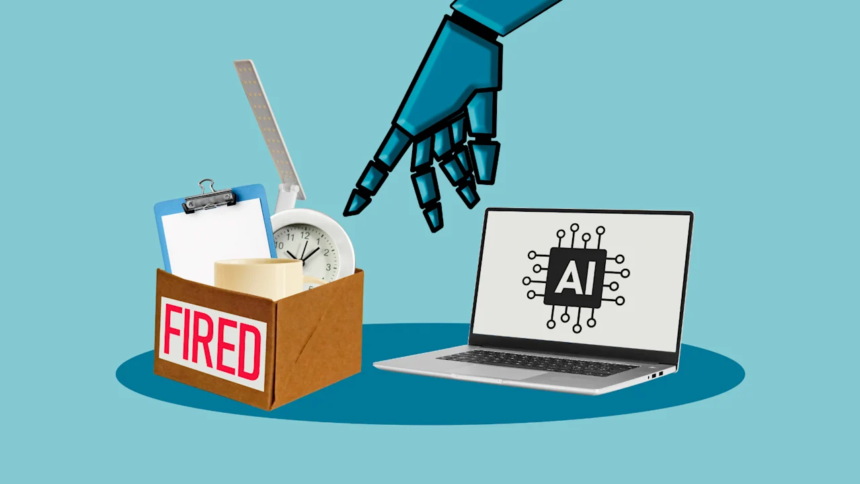

In October 2024, I wrote that the tech industry was entering an era of silent firing. Jobs were not being eliminated overnight, but subtly reshaped in ways that encouraged attrition, as companies quietly prepared for large-scale automation. At the time, this was largely a warning. With age, it looks more like a pattern.
Amazon’s January 2026 announcement of 16,000 layoffs brings corporate staff reductions to roughly 10% of its workforce. Publicly, leadership has been careful to separate these cuts from artificial intelligence. As CEO Andy Jassy put it after earlier reductions, “the announcement that we made…was not really financially driven, and it’s not even really AI-driven, not right now at least.” Yet in parallel, Jassy has been explicit about the role AI is already playing across the company, stating that “in virtually every corner of the company, we’re using generative AI to make customers’ lives better and easier,” and that new AI-driven agents are “coming, and coming fast.” The tension between these two statements highlights a growing accountability gap: AI is framed as transformative when speaking to investors, but incidental when explaining workforce reductions.
A NEW MODEL IS NEEDED AFTER AI INVESTMENTS
Let’s look at the case of Meta (Facebook). They will either have to trim other expenses significantly or start charging users. Meta’s current global average annual revenue per user sits at roughly $13–14. On the higher earning side are the U.S. and Canada, at around $68 per user. Seeing as Meta’s fastest user growth markets are in Asia-Pacific and developing countries, that $13-14 figure is more likely to go down rather than up.
Consider Meta’s commitment to spend $600 billion on infrastructure by 2028. Divide this by 3 billion Facebook users, and they would need to squeeze an additional $200 per year from each user just to break even on this investment alone. Said differently, they would have to ~15x their annual revenue per user to match this spend. This does not factor in their aggressive acquisitions in the AI space, which adds to payroll and layoff costs post-acquisition. The math is simple: Meta will need to find new revenue sources from a user base already inundated with ads. Or more likely, the most obvious target is to cut expenses, with headcount made redundant by their own AI investments.
We are seeing evidence of this accelerating towards a head: Meta is planning to track employees’ clicks and keystrokes to train AI. This seems like the exact step you would take before fully automating jobs and firing workers.
S&P RISES WHEN JOB POSTINGS FALL
What is notable is how early this shift appeared in the data. Since the launch of ChatGPT in October 2022, job postings have decreased by one-third, while the S&P has risen by 75%. This presents an eerie reversal of historical norms, where periods of market expansion have traditionally been driven by hiring, not job cuts. We still have not yet reached widespread AI deployment, yet hiring behavior has already adjusted!
This suggests we are still in the first phase. Companies are cutting staff while simultaneously insisting that AI is not the cause. That framing may hold for now, but it becomes harder to maintain as automation capabilities expand and productivity gains become more visible.
From here, there are two likely paths. One is continued workforce reduction as AI replaces more tasks. The other is accelerated monetization. OpenAI’s recent move toward introducing ads into its free product hints at a future where users trade experience quality for profitability. Either way, the pressure to justify massive AI investment is only increasing. We already see cracks forming on spend: OpenAI lowered its $1.4 trillion spending forecast to $600 billion.
This is no longer a theoretical problem; it is already here. Programmer employment fell 27.5% from 2023 to 2025. In 2023, KPMG cut its new graduate hiring by 29%, while Deloitte Australia decreased hiring by about 18% that year. In the U.S., entry-level job postings declined about 35% between January 2023 and fall 2025. A 2025 IDC/Deel survey found that 66% of global enterprises plan to cut or slow down entry-level hiring, due to AI.
HONESTY MATTERS
This is not an argument against AI. It is an argument for honesty, responsibility, and structure. As these changes continue to unfold, leadership must clearly explain how automation is reshaping work and put real frameworks in place to manage that transition. Without accountability and action taken soon, we risk drifting toward a dismal future where efficiency accelerates, trust erodes, and leaders continue to speak out of both sides of their mouths.
These companies have a real responsibility to be far more honest about what’s coming. They need to do this so our economic systems can start preparing for the impending job losses, understand what kinds of positions will be eliminated, and determine what retraining might work well for this new job market. Either these organizations need to think about expanded responsibility for large-scale job cuts, or the government does. If everyone is going to act surprised when this happens, the magnitude of the impact will be much worse.
George Kailas is CEO of Prospero.ai.

