





The company that pulled onto the road nearly 16 years ago as UberCab increasingly seems less interested in driving than in what users do before and after summoning a ride through its app.
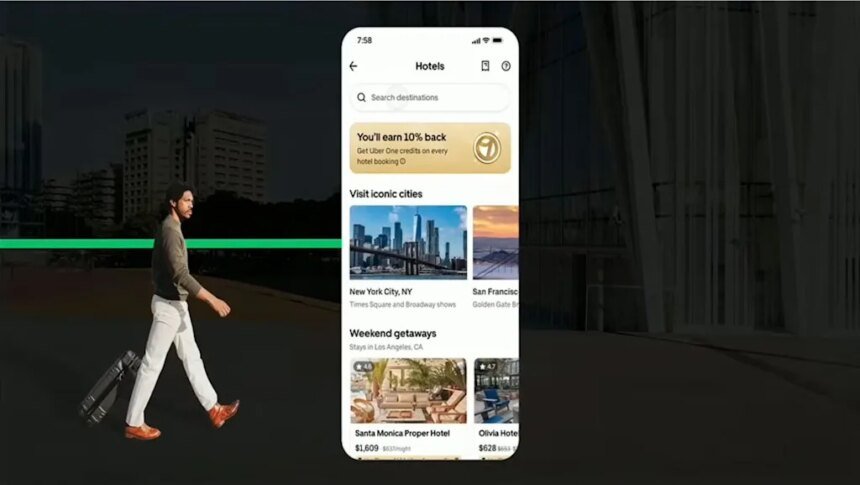
The latest evidence of Uber’s shift toward becoming a broader services platform came at its Go-Get event this week in New York, where the company led with hotel keys instead of car keys.
“I believe that Uber truly offers one service: We give you your time back,” CEO Dara Khosrowshahi said at the start of the company’s roughly 40-minute presentation.
The features unveiled invited a new comparison for Uber, not to ride-hail rival Lyft, but to one of its corporate neighbors in San Francisco: Airbnb.
Much like Airbnb’s expansion into “experiences” and other services, alongside its move into listing boutique hotels, Uber’s latest offerings suggest similar ambitions to make its app indispensable throughout an entire trip.
But ambitions that sweeping, captured in the “One app for everything” headline of Uber’s press release, warrant scrutiny over what customers actually gain from this single-app convenience.
(See also: Elon Musk’s still-unrealized plans to turn X into an “everything” app.)
Uber, but for hotels
Consider the in-app hotel booking feature that opened the presentation, which essentially embeds the hotel-search functionality of Khosrowshahi’s former employer, Expedia, and routes it through Uber’s payment system.
“Booking a hotel on Uber is going to feel as easy as booking a ride,” VP of Product Amit Fulay said onstage.
Subscribers to Uber’s $9.99-per-month Uber One membership, the subject of a Federal Trade Commission lawsuit filed in April 2025 over allegedly deceptive marketing, receive additional perks: at least 20% savings at what small print on a slide described as “a rolling list of properties,” along with a 10% rebate in Uber One credits.
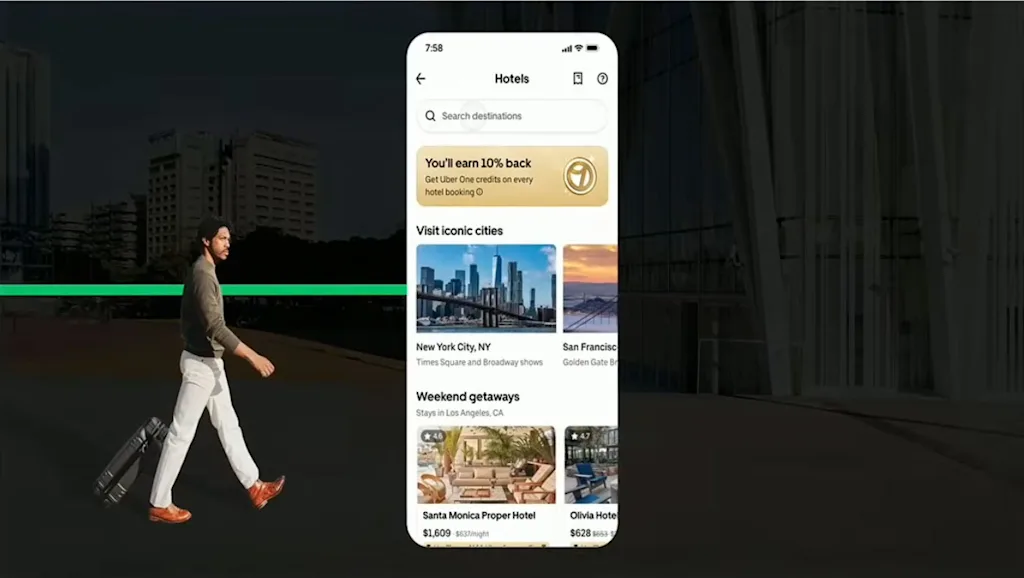
As any expert in travel-loyalty programs can tell you, booking a hotel through a third-party site often means forfeiting rewards points or elite-status credits within a hotel chain’s own program. Uber’s approach effectively assigns that loyalty role to itself, much as Expedia does through its One Key rewards program.
That could still work in your favor, depending on how you value Uber One credits compared with points from hotel brands like Marriott. But travelers should understand that this trade-off exists.
Fulay noted that Uber’s app will allow users to filter hotel listings by price, reviews, amenities, and other criteria, but the default ranking remains unclear. A search I ran during Uber’s event for a downtown Chicago hotel from May 8 through May 10 surfaced the Trump International Hotel and Tower as the top result, with a discounted total of $1,322. Even among luxury properties near the Loop, better options are available.
I could not repeat that search after returning to D.C., where my copy of the app listed hotel search as “Coming Soon.” Representatives for Uber did not say whether you could set preferences in the app to rank or downrank hotel brands, so in this scenario you may not be able to 86 Trump.
Uber, but for travel advice
Another new feature builds on a behavior Khosrowshahi proudly highlighted onstage: “We’re the first app that you open when you get into your city.”
Travel Mode, which may soon appear in the app when users visit other cities, is designed to keep them returning. If you land at one of the 29 airports where Uber offers wayfinding (though the company has not yet published the full list), the app will provide walking directions from your terminal to the designated ride-hail pickup area.
That sort of guidance could prove genuinely useful in unfamiliar airports, which helps explain why airlines like United and Delta have offered similar features for years.
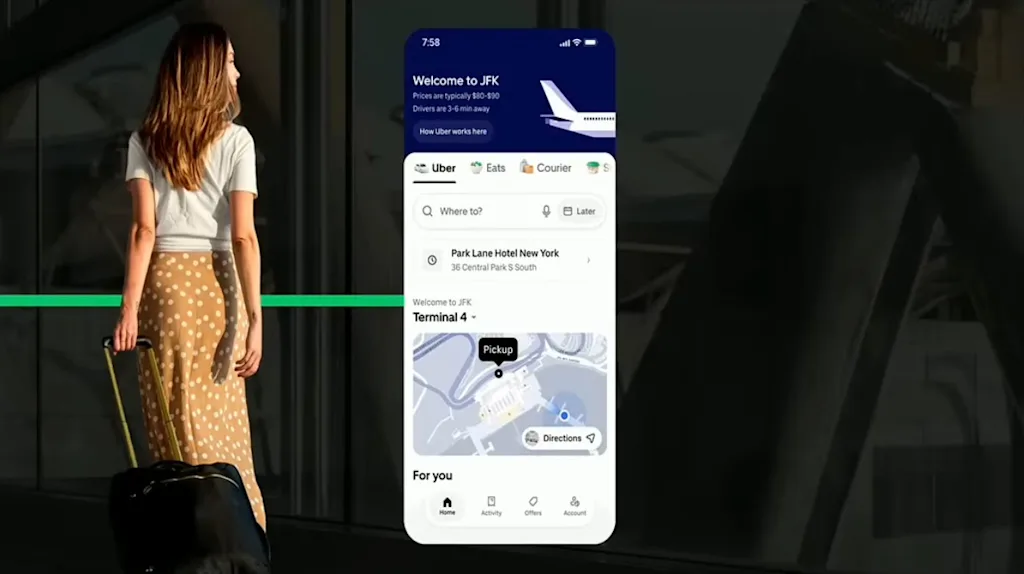
But unlike Uber’s standard ride search, Travel Mode surfaces only rides bookable through Uber. That may be a practical option at many airports (Las Vegas comes to mind), but in others the design could steer travelers toward unnecessarily expensive rides while overlooking cheaper public transit options that, especially during rush hour, may get them downtown faster.
Uber’s own presentation offered an inadvertent example. A screenshot of Travel Mode showed fares of $80 to $90 from JFK Airport to a hotel on Central Park South in Manhattan. Mid-afternoon Thursday, Google Maps and Apple Maps listed shorter travel times for that route via the JFK AirTrain and New York City subway, despite requiring two transfers. The cost per rider: $11.75.
In an interview afterward, Fulay said Uber intends to broaden the range of transportation choices shown in this interface.
“We do have a trains product,” he said, referencing Uber’s in-app train booking in the U.K. “Our goal is to show you various multimodal options.”
Other aspects of Travel Mode do suggest smoother travel, including “curated” local restaurant recommendations with integrated OpenTable reservations, as well as the option to have food, clothing, and travel accessories delivered directly to your hotel. But travelers may want to avoid following one example featured in Uber’s presentation: paying $15.99 for an Apple-branded USB-C cable.
Uber, but for personal shoppers
Another Uber announcement Wednesday felt, at least in part, like an effort to revive the spirit of dot-com-era delivery service Kozmo.com: an upcoming feature called “Shop for Me.”
The service will allow time-strapped customers to submit a detailed description of an item they want from a store, along with a photo, if necessary, and have one of Uber’s highest-rated couriers visit that location—even if the retailer is not part of Uber’s platform—purchase the item after confirming it meets the customer’s needs, and then deliver it.
What remains less clear is how much couriers will earn for what appears to be a relatively high-touch service.
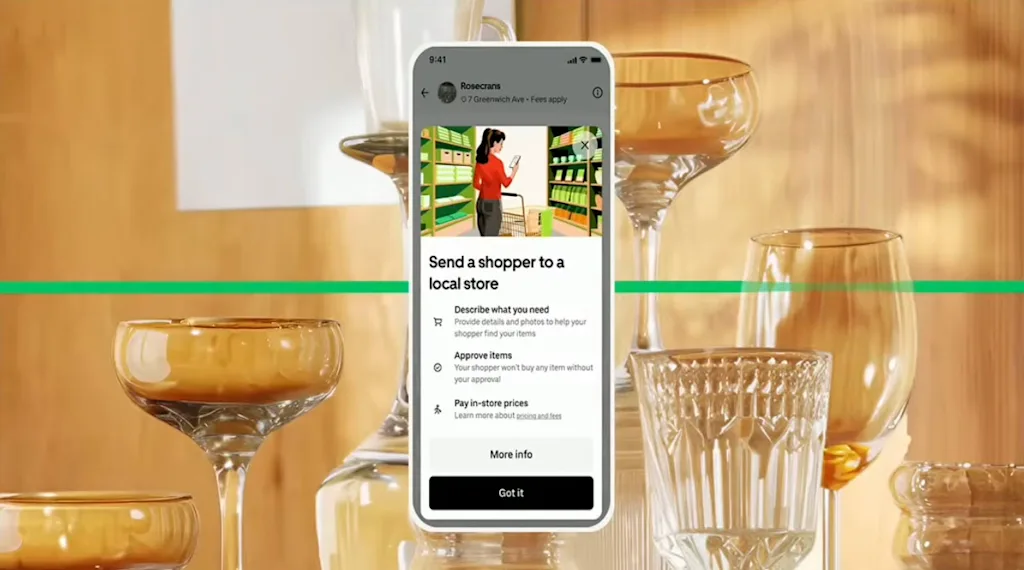
Uber executives did not address compensation details during the Go-Get event, though Fulay said afterward that the earnings would be “compelling.” Uber did roll out a tip guarantee for couriers in early April, but customers would still be wise to tip generously for a service like this.
The workers powering Uber’s convenience economy remained largely invisible throughout the New York presentation. Most notably, company leaders did not discuss the relatively limited measures Uber has taken to offset rising fuel costs for drivers as gas prices have climbed amid the Iran war.
No such tipping concerns apply to the AI-powered shopping tools Uber is adding to its Cart Assistant, first introduced in February. One feature will allow users to photograph a meal, have AI generate a list of likely ingredients, and then automatically assemble a grocery order based on that analysis.
Uber’s road ahead
Seeing transportation take a back seat at an Uber event felt striking, given the company’s recent history. Last year’s Go-Get event, for example, focused on more affordable ride options, including bus-like Route Share scheduled service and shared autonomous-vehicle rides.
But Uber’s own earnings reports underscore its evolution into a broader services company. Operational metrics from the fourth quarter of 2025 show the gap narrowing between its “Mobility” and “Delivery” divisions, with delivery growing faster in both gross bookings ($27.4 billion to mobility’s $25.4 billion) and revenue ($8.2 billion to $4.9 billion).
Against that backdrop, one final feature unveiled at this year’s Go-Get event comes as little surprise: Uber’s app home screen, which already elevated delivery and other non-transportation services in a 2023 redesign, will soon add a “One Search” interface that surfaces all relevant service options for a user’s query instead of defaulting to transportation.

