






This story was originally published in On Background with Mark Stenberg, a free, weekly newsletter that explores the key themes shaping the media industry. You can sign up for it here.
At Advertising Week, amid conversations about agents, creators, and combating fragmentation, an unusual topic kept coming up: out of home.
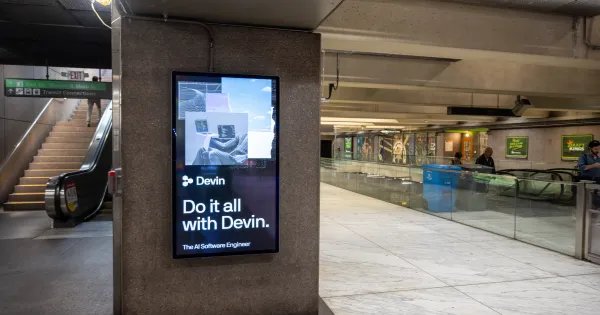
The relatively fusty advertising channel has, in recent years, taken on renewed relevance. Out-of-home advertising, an industry catchall for media including billboards, wheatpastes, leaflets, and other in-person formats, has benefited from a surprising confluence of tailwinds.
Its digital counterpart, somewhat unimaginatively called digital out-of-home media (DOOH), is increasingly seen as offering the best of both its digital and analog components: unskippable, yet targeted and programmable.
The numbers reflect this renewed interest. U.S. out-of-home advertising revenue grew 10.7% year over year in the second quarter, reaching a record $3.16 billion, according to the Out of Home Advertising Association of America. Digital-out-of-home grew even faster, rising 18.5% and accounting for nearly 40% of the category’s revenue.
Taken more broadly, the resurgence of out-of-home reflects a potentially more consequential shift in advertising: As the internet becomes less trustworthy, less trafficked, and increasingly mediated by artificial intelligence, physical space is becoming more valuable.
Dedicated readers of On Background will recognize part of this dynamic. For media companies, in-person events have been one of the few consistent bright spots in an otherwise challenged advertising environment. Publishers from Condé Nast to Semafor to ADWEEK itself have invested significantly in their events businesses, which in some cases now make up more than half of their revenue.
There are several explanations for that growth. The rise of remote work has created a more distributed workforce with fewer consistent opportunities for networking and convening. Events solve that problem neatly.
More broadly, in-person media offers something increasingly scarce: a tangible, memorable experience, rather than the ephemeral one of scrolling past a display ad or skipping through an ad read.
Now, a host of new factors are making that distinction even more meaningful.
The rise of artificial intelligence has unleashed an onslaught of low-quality content—often referred to as slop—whose provenance will only become harder to discern as the technology improves. Consumers are already growing more skeptical of what they encounter online. According to a 2024 Adobe report, 87% of U.S. consumers said the rise of generative AI has made it harder to distinguish fact from fiction online.
That erosion of trust was one of the reasons Mariano Jeger, the former executive creative director at Droga5, cited for his departure to Outfront Media when I spoke to him this past September. As digital and social content become easier to manufacture and harder to authenticate, brands have new reasons to reconsider the relative value of appearing in those environments.

