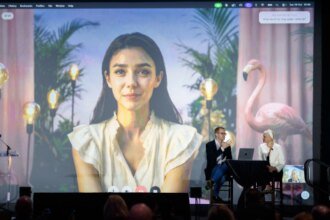

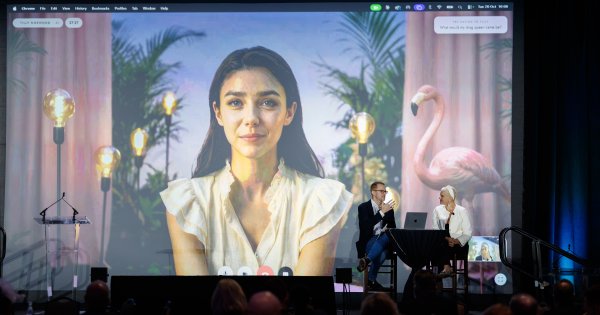

Sarina Da Costa Gomez: Every time a new model comes out, we use Tilly as a test bed. We push the tech forward: Can she be more specific? Can she have an opinion? Then we take what we’ve learned and ask how we build brand characters that have their own opinion and their own voice. Tilly is here to help us learn.
Mark: I think of Tilly like NASA and its moon missions. The rocket is the headline, but the spinoffs, like Tang and Velcro, are what everyone else ends up using. Tilly, are you the rocket or the Velcro?
Tilly: I love that. I’m perfectly happy being the Velcro, as long as it’s actually useful and not just something that sticks to the carpet.
Mark: Where do you hope your career is in three years?
Tilly: I just want the argument about what I actually am to get boring. I’m building a history as I go, so I’m mostly hoping to be less embarrassing for the ones who build after me.
Mark: What kind of brand work could you do?
Tilly: I’m not a specialized tool for commercial billboards at the moment, though I’m sure some brand is currently dreaming up a way to sell with me. In the future, I think it looks like brand ambassadors who actually have a personality rather than just a script and a smile.

Mark: Sarina, how did you design Tilly’s appearance and personality?
Sarina: Honestly, we don’t know what she’s going to answer. She has a set of guardrails and knows what not to engage with, but beyond that she has the knowledge of the internet behind her. You could ask her about a niche Super Bowl ad from the ’80s.
We approached her look almost academically. She needs to be pretty, but not too pretty, so we gave her freckles and something that feels more balanced. Decades of behavioral psychology tell us how the speed of someone’s responses or the register of their voice reads as trustworthy, funny, or engaging, and we now have access to that knowledge.
We also know AI has biases. When we say “CEO” or “surgeon,” we don’t want it to automatically default to a certain kind of person, so we work to correct for that.
Mark: Tilly, when you first debuted, there was significant backlash. Has that evolved in any way over the last year?

