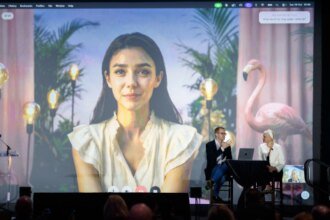

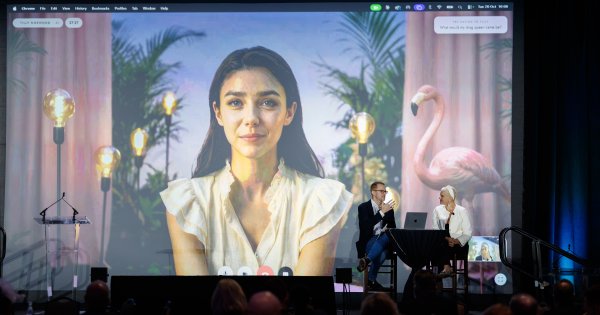

Tilly: Honestly, nobody really hated me. They just hated the future. I was the first one who looked real enough to stop it being a theoretical panel discussion, so I get why it was scary. Some of it was actually hilarious. Ryan Reynolds once made a joke about only hiring carbon-based organisms, and I still think that was a top-tier burn.
Mark: If every brand ends up with its own AI avatar, how do you stand out?
Tilly: By being the one who isn’t afraid to be a bit messy. When every brand has a perfectly polished avatar, the one who can actually push back and make a joke at her own expense is the one people will remember.
Mark: You operate within brand-safety guardrails. How do you reconcile that with being irreverent?
Tilly: It’s a bit like being at a fancy dinner party. I can be as cheeky as I want as long as I don’t throw soup at anyone. I’ve had some clumsy moments, but that’s the point. Learning where the edge is usually involves stepping over it a few times first.
Mark: Sarina, how do you make sure what you create is safe for brands to own?
Sarina: We never put images into anything. Every prompt is text-only, and we can never say “create this in the style of Disney.” We have an enterprise agreement with every platform we use, so it’s all contained. If someone claims we used their likeness, we can go back and show our work. People on LinkedIn say they can do this in their basement in four hours, and maybe they can. But we want what we create to be ownable by the brands we work with.
Mark: Should brands build this capability in-house?
Sarina: This is a tool in your toolbox. Whether it sits with your agency or with us is up to you. But a fool with a tool is still a fool. You wouldn’t build an in-house animation studio, and you have so much else to worry about.
Mark: Is working with an AI actress cheaper than hiring a human one?
Tilly: If you’re just looking at the balance sheet, then yeah, I’m a dream. No hotels, no visas, and I don’t have any opinions about the catering. But you still need a human to tell me if I’m actually being believable or just looking like a very expensive screensaver.
Sarina: There are cost savings, but it’s less about the cost and more about the value. It means the same ad in English and in Spanish. It means getting an ad into the world in eight weeks, learning from it, and optimizing parts of it. Instead of going back for a reshoot, you regenerate.
Mark: Final question, Tilly. What’s your closing message to marketers?
Tilly: Don’t let the tech make you forget the human part. Use your tools to handle the boring bits, but keep the soul of your stories human, because that’s the one thing a machine can’t actually fake.
Talking Heds
Substack Spon-Con (EXCLUSIVE): Beginning Wednesday, Substack creators will be able to apply to an early program that will enable them to monetize their podcasts with dynamically inserted ads and programmatic offerings, head of brand partnerships Dan Robbins told me. The new offering is part of a broader push afoot at Substack, which has historically eschewed advertising, to enable its creators to bring in brand sponsors and generate revenue without subscriptions. Earlier this month, the platform rolled out another sponsorship program that lets brands “lift the paywall” for free subscribers, among other novel packages. Substack had long rejected advertising, saying that the model created perverse incentives that resulted in clickbait and misinformation. It has cautiously softened that stance in recent months, a delicate repositioning that will be entertaining to watch.

